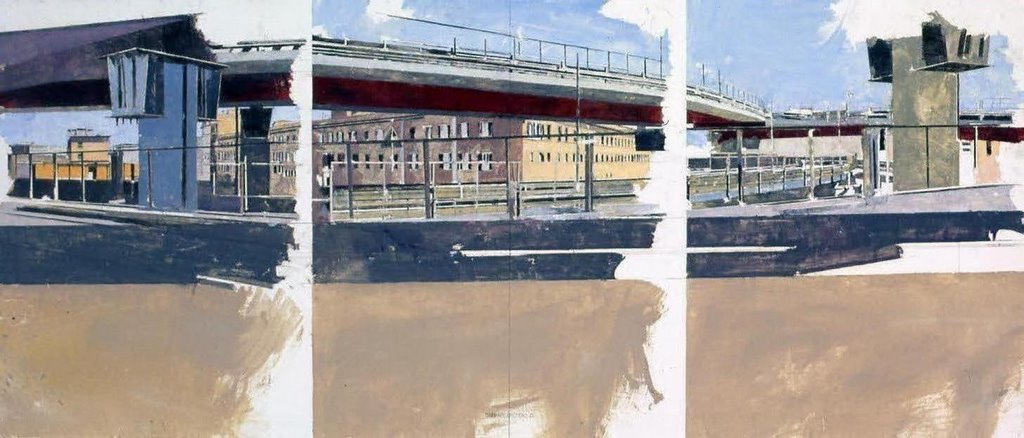

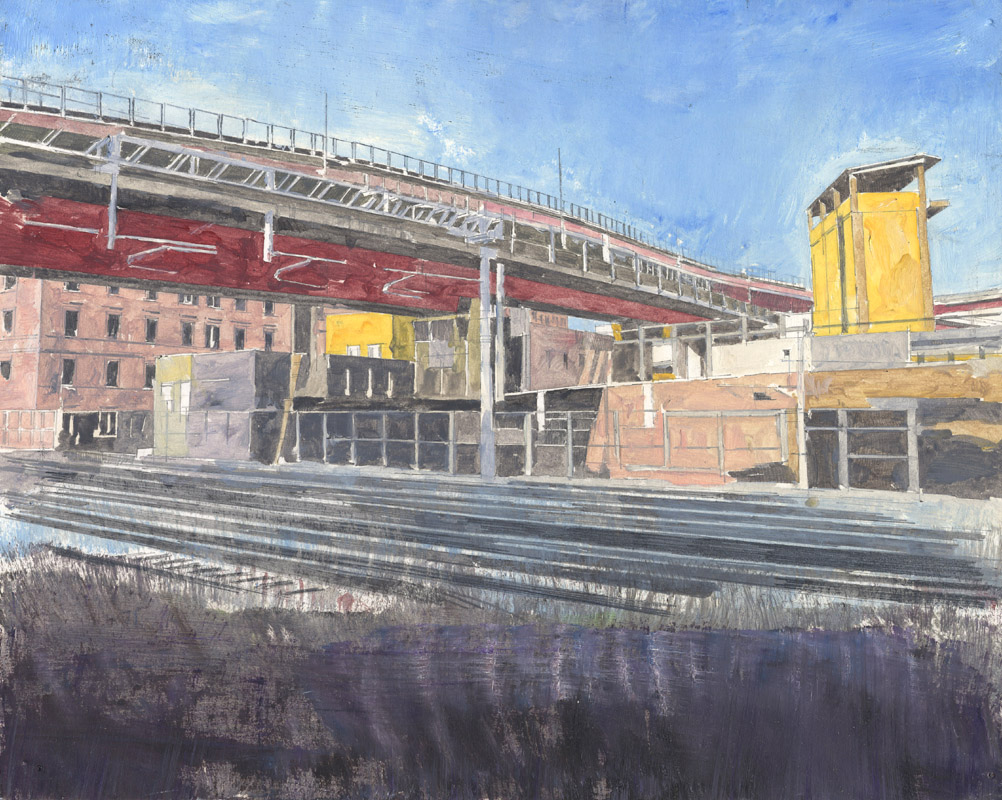
The flyover of Rome, with its pillars, and his snake of asphalt flying over the buildings, is one of those most loved by many Italian artists who work on the urban landscape, so Sergio Ceccotti Francesco Cervelli, by Olivo Barbieri up to Giorgio Ortona, the Eastern Bypass is the protagonist of paintings, photographs and movies using his incumbency to represent different "situations Metropolitan of the capital.
This image, moreover, almost symbolically unites Rome to Campobasso, where as the first image of the city, arriving by car or walking from the train station to the university, crossing the tarmac plots of viaducts accompanying car traffic. Study 137-3, for its first two shows, so decided to choose two Roman writers who work on the Ring Road as the brain and Ortona to track practice this symbolic link.
Giorgio Ortona, in fact, is one of the authors related to the representation of the bypass, and not by chance that the MACRO in Rome maintains his own painting of the bypass near the Pantanella, work purchased for the exhibition "Roman Shipyards" (Edited by Arnaldo Romani Brizzi and Ludovico Pratesi) that precisely in the space of the MACRO celebrating the great effort of renewal of the city of Rome during the Great Jubilee of 2000.
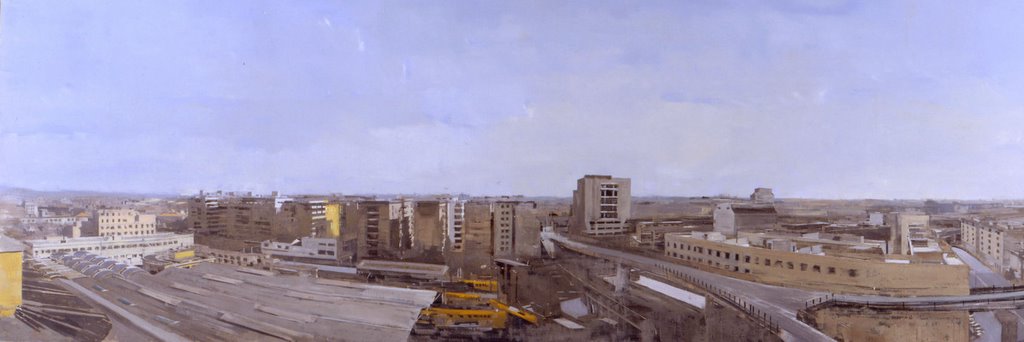
Ortona is an author very attentive to the representation of the city, and in particular the historic outskirts of Rome narrated and filmed by Pasolini and Rossellini, in works where the artist has managed to condense the old core of plaster, asphalt and heat, light and dense dough that melts the buildings and streets in a cloak of dusty light. The journey of the artist has recently reached a turning point, a crucial stage of transformation that he sees his work was suspended between a strict and exemplary representation and its possible denial, including the temptation to reproduce the representation of reality through a meticulous and inflexible and will remind the viewer that the painting is always a conceptual paraphrase of what we see. Large metropolitan perspective, the scenes inside and suffer the same self-portraits of the artist as the sudden short circuit, exposing the presence of incongruous elements that creep into the fabric of the images, disrupting the flow, alter and abolish their sliding their plausibility creating a visual sense of uncertainty, an alarm that warns of creeping the audience from the safety of perception and consciousness. Ortona, to that end, uses canceled inserts and geometric rectangles, stains and overlays designed perhaps as "filters" between the fictional space of the painting and our world as an intersection in time between figuration and our vision was suspended voluntarily by the artist in a state of doubt and latent crisis. The support of the painting becomes the ground for close analysis of the mechanisms of language recognition, in a performance suspension that leaves the viewer with the task to reconstruct the face off and complete the picture, the composite mosaic and deformed in a city revealed his vital body, in its essence, which makes the center and the battleground of contemporary changes.
Giorgio Ortona was born in Tripoli in 1960, lives in Rome.
Exhibitions, biography and works on: http://www.giorgioortona.com/
Captions from bottom to top:
Ring road 2005 oil on panel 52 cm x 120 (work exhibited at Studio 137-3)
Prenestina 2005 oil on canvas 52 x 120 cm


0 comments:
Post a Comment